Can you really get paid to walk?
Yes — several legitimate apps reward users for walking, reaching step goals, completing activity challenges, or participating in health and fitness programs.
But there is an important distinction to understand before downloading anything: most walking-reward apps do not pay you a traditional wage for every step you take. Instead, they may give you points, coins, gift cards, discounts, cash rewards, or other perks.
Some apps reward walking directly. Others combine walking with surveys, shopping, challenges, research studies, or promotional offers. And some, such as StepBet, require you to put your own money into a fitness challenge before you can potentially win money.
That means the best walking app isn’t necessarily the one advertising the biggest possible payout. The better question is:
Which app gives you the most useful reward for the walking you’re already doing?
We looked at the major walking-reward platforms available to U.S. users and compared them based on reward structure, ease of use, cash-out options, tracking, transparency, and the amount of effort involved.
Our approach: BetterPickForYou does not treat advertised earning potential as guaranteed income. Reward rates, offers, availability, and redemption requirements can change, so always check the current terms inside the app before you start.
Best Apps That Pay You to Walk
Not every app below works in exactly the same way. That’s why we have separated ordinary walking-reward apps from fitness-betting and charity-focused platforms.
1. Evidation — Best for Passive Health Rewards
Best for: People who want to earn rewards from everyday health activity
Available on: iPhone, Android and Web
How it works: Connect supported health and fitness apps, earn points from qualifying activity and other actions, then redeem your points.
How walking is tracked: Through connected services such as Apple Health and supported fitness apps/devices.
Rewards: Cash, gift cards and charitable donations
Cash-out: 10,000 points = $10
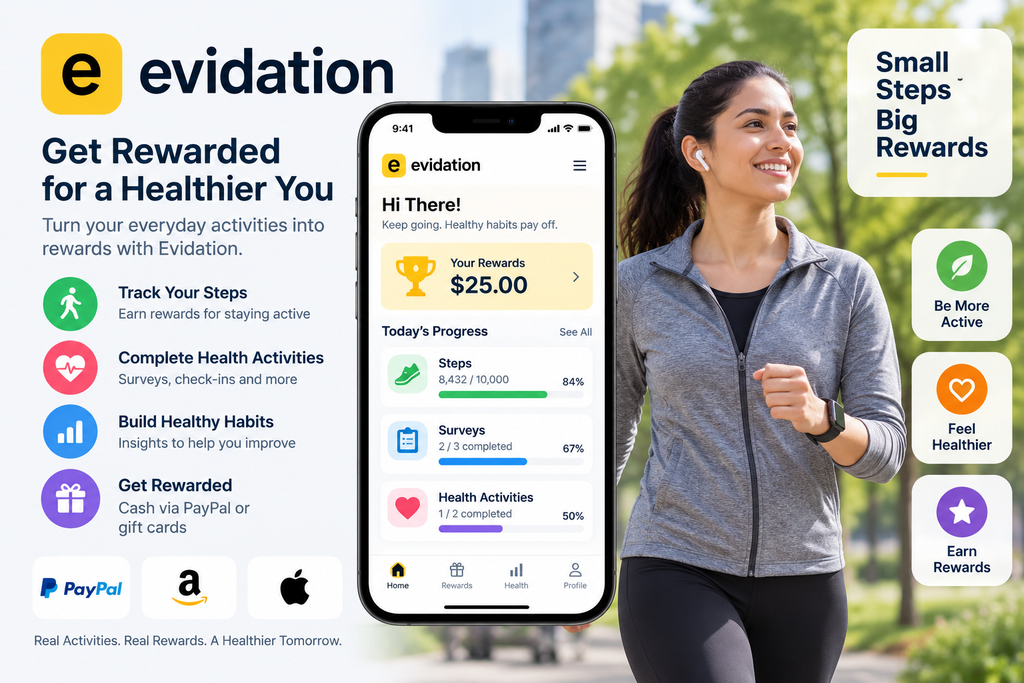
Evidation is different from a typical “walk for coins” app.
Rather than simply converting every group of steps into a fixed amount of cash, Evidation rewards users for a range of healthy activities. These can include walking, exercise, sleep, nutrition and other health-related actions, along with in-app cards, surveys and research opportunities.
Evidation currently states that users can redeem 10,000 points for $10, with rewards delivered through its payment partner, where users can choose options such as bank transfer, PayPal transfer, gift cards or donations.
For synced activity, Evidation currently allows up to 40 points per day across five activity categories, with walking/wheelchair activity representing one of those categories. The company also says that the time required to reach 10,000 points varies considerably depending on whether you also complete cards and other activities.
That last point matters.
Evidation should not be viewed as a simple “10,000 steps = $10” app. The 10,000-point redemption is real, but points come from several types of activity.
Evidation also supports a range of connected health and fitness services. Its current documentation lists Apple Health, Fitbit, Garmin, Samsung Health and other integrations.
Pros
- Supports passive health/activity tracking
- $10 redemption threshold
- PayPal and bank-transfer options through its reward partner
- Can reward more than walking
- Broad fitness-device/app compatibility
Cons
- Walking alone can be a slow way to accumulate enough points
- More meaningful rewards may require completing additional activities
- Users need to pay attention to activity syncing
Our verdict
Evidation is one of the best choices for people who want walking rewards without constantly interacting with the app. It is especially attractive if you already use a compatible health or fitness tracker.
One important 2026 change: Google Fit connections have changed, and Evidation currently recommends Apple Health or other supported sources for continued syncing in relevant cases.
2. CashWalk — Best for Step-Based Gift Cards
Best for: People who want their walking converted into gift-card rewards
Available on: iPhone and Android
How it works: Walk with the app tracking your activity, collect coins and redeem them for gift cards.
Rewards: Gift cards including popular retailers
Cash-out: Varies by current reward
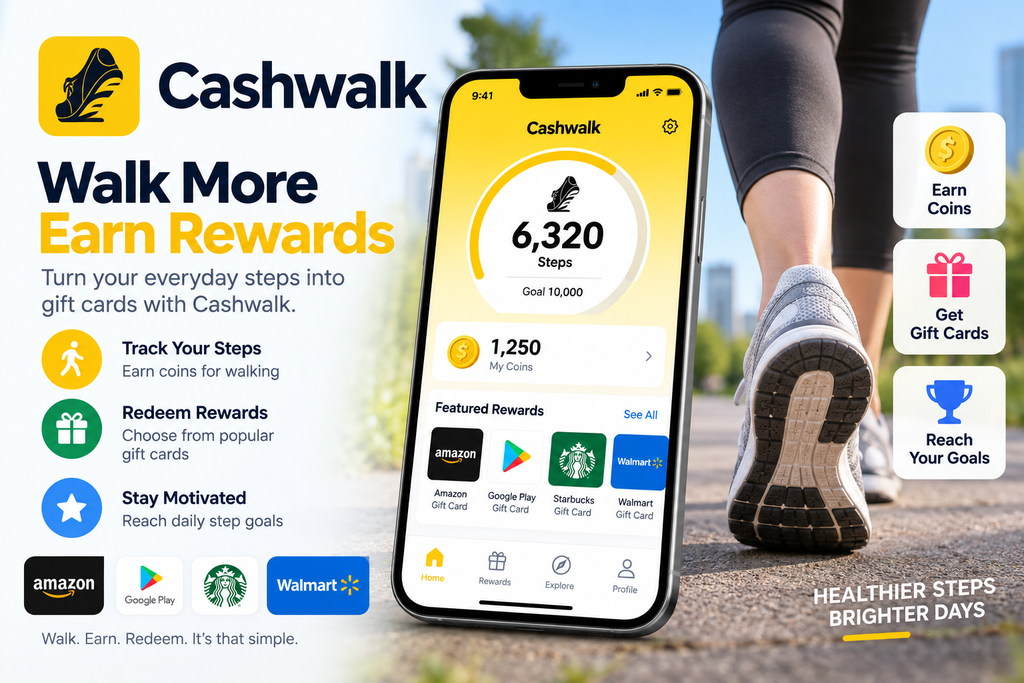
CashWalk is much closer to what most people imagine when they search for an app that pays you to walk.
Its current website describes CashWalk as a free pedometer that converts daily steps into coins that can be redeemed for gift cards. It lists rewards from retailers including Amazon and Walmart and says the app can track up to 20,000 steps per day.
CashWalk’s official FAQ currently states that users earn 1 coin for every 100 steps, but the coins need to be collected manually using the treasure-box feature before the daily reset.
This manual collection requirement is an important detail.
You can walk all day and still miss the opportunity to collect some of your coins if you don’t follow the app’s current collection rules.
The app also supports both iPhone and Android and states that it does not require GPS for its basic step-counting functionality.
However, don’t assume that a particular number of coins always equals a fixed dollar amount. Gift-card requirements and reward catalogs can change.
Pros
- Directly focused on walking
- Available on iPhone and Android
- Gift-card rewards
- No GPS needed for basic step counting
- Straightforward concept
Cons
- Coins may need to be manually collected
- Reward requirements can change
- Advertisements and additional promotional features can be part of the experience
Our verdict
CashWalk is one of the better choices for readers who specifically want gift cards in exchange for everyday walking.
Just don’t calculate your expected income using an old blog post’s coin-to-dollar conversion. Check the current reward catalog inside the app.
3. WeWard — Best for Walking, Challenges and Extra Rewards
Best for: People who enjoy a more gamified walking experience
Available on: iPhone and Android
How it works: Earn Wards from steps and other eligible activities, then use them toward available rewards.
Rewards: Cash, gifts, discounts and charitable options
Cash-out: Varies by reward and location
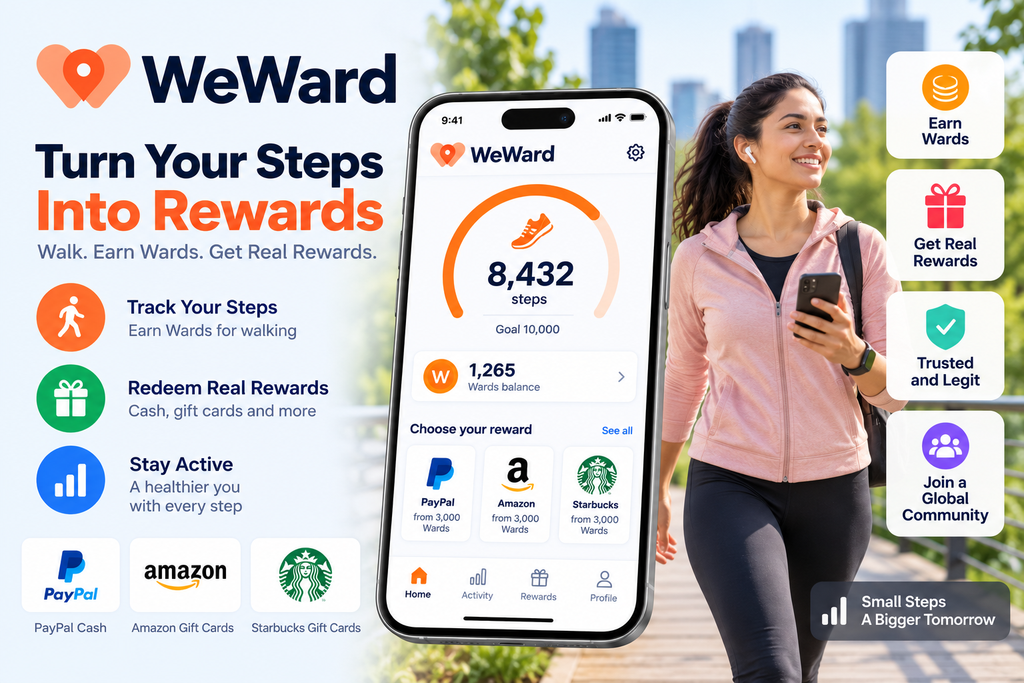
WeWard turns walking into a broader reward system.
Its current website says users can convert their steps into cash, gifts and donations, and that cash rewards can be paid through PayPal or Venmo. It also promotes brand deals, challenges and other activities.
WeWard’s March 2026 terms explain that users receive Wards for actions promoted in the app, including the number of steps taken and certain bonus activities.
That means WeWard isn’t simply a fixed-rate step counter.
Your total rewards can depend on which activities, challenges and promotions are available to you.
The platform can also require payment-service details such as PayPal or bank information for cash rewards and may require identity or age verification in some situations.
Pros
- Walking-focused experience
- Cash reward options
- PayPal and Venmo availability
- Challenges and gamification
- Gift and charitable reward options
Cons
- Reward rates can vary
- Some rewards depend on additional activities
- Cash redemption requirements can vary by region
Our verdict
WeWard is a strong choice for people who want walking to feel more like a game than a passive step counter.
4. Winwalk — Best for Simple Android Walking Rewards
Best for: Android users who want a straightforward step-reward app
Available on: Android
How it works: The app uses your phone’s pedometer to count steps and award coins.
Rewards: Digital gift cards
Cash-out: Varies by available gift card
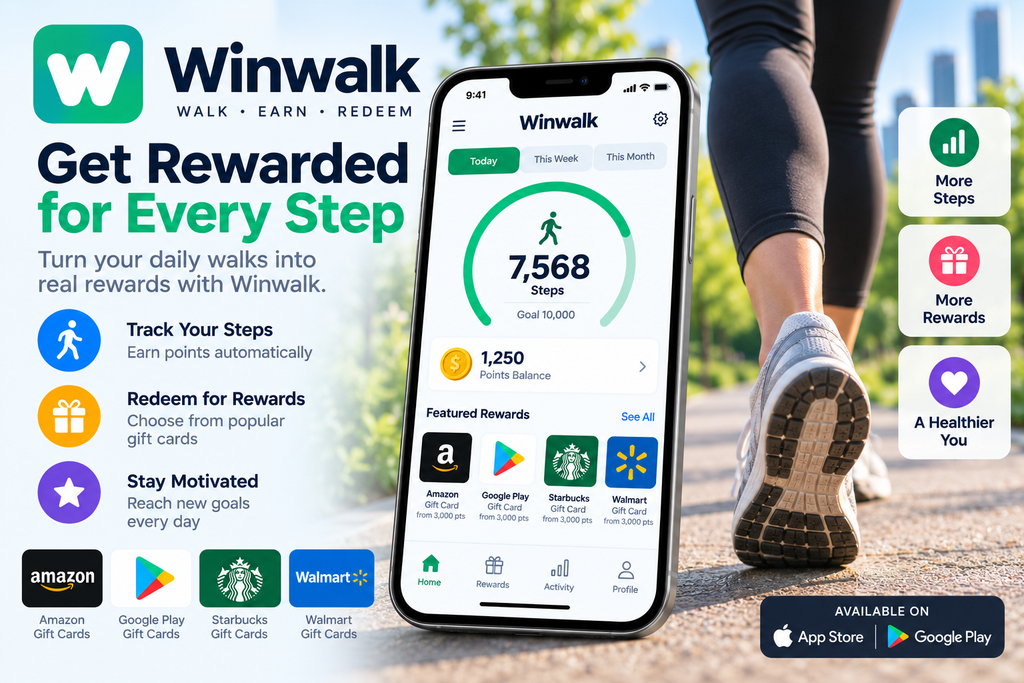
Winwalk keeps its basic concept simple.
Its current Google Play listing says the app awards 1 coin for every 100 steps, with a maximum base reward of 100 coins per day, and that coins can be redeemed for gift cards including Amazon, Walmart and Google Play. It also says basic step tracking uses the phone’s built-in pedometer and doesn’t require GPS.
The same listing says users don’t need an account, phone number or email address to start using the basic service.
That simplicity may appeal to people who don’t want a complicated rewards ecosystem.
However, there is an important limitation: Winwalk is Android-focused, so it isn’t the best option for iPhone users.
Pros
- Simple step-counting system
- No GPS required for basic tracking
- Android app
- Gift-card rewards
- Low-friction setup
Cons
- Android only
- Daily base step reward is capped
- Gift cards rather than standard PayPal cash
Our verdict
Winwalk is worth considering for Android users who want a basic walking-reward app without a complicated setup.
5. Sweatcoin — Best for Walking Rewards and Marketplace Offers
Best for: Users who enjoy rewards, deals and the Sweatcoin ecosystem
Available on: iPhone and Android
How it works: Verified steps are converted into Sweatcoins that can be used within the app.
Rewards: Marketplace offers, vouchers, sweepstakes and other promotions; $SWEAT through the separate Sweat Wallet ecosystem
Standard PayPal cash-out: No
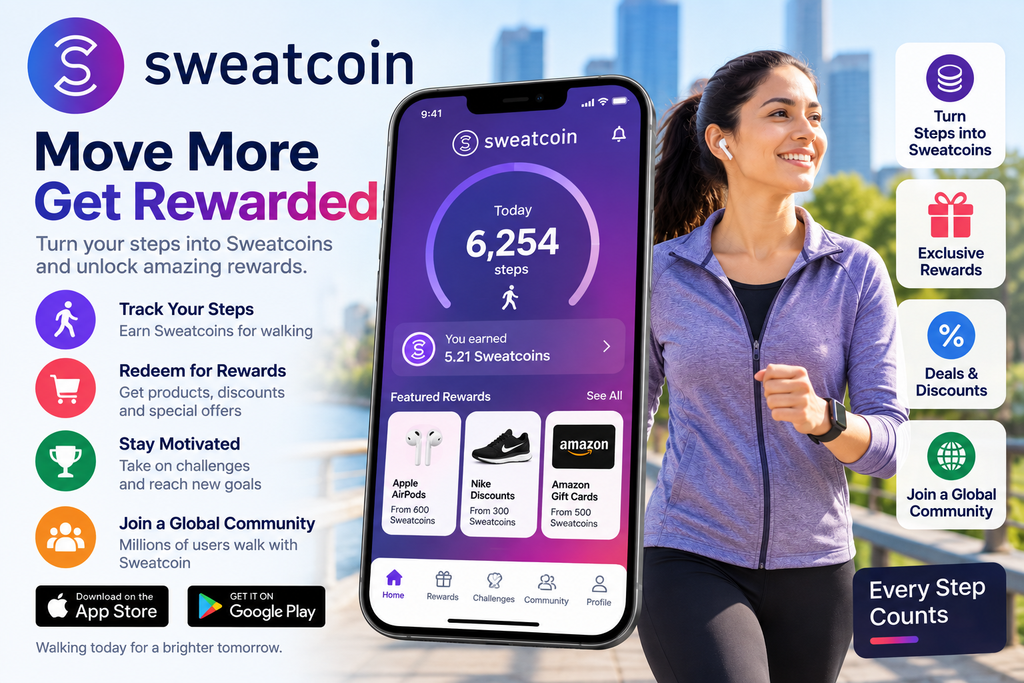
Sweatcoin is one of the best-known names in the walking-rewards industry.
Its current support documentation says the app verifies steps and converts them into Sweatcoins. Its stated conversion is 1,000 verified steps = 0.95 Sweatcoins, reflecting a 5% commission.
But here’s the important distinction:
Sweatcoins are not the same thing as dollars.
Sweatcoin’s current support documentation says users cannot directly cash out their Sweatcoin balance to PayPal or a bank account. PayPal or Amazon vouchers can sometimes appear through its auctions, while the separate Sweat Wallet provides access to the $SWEAT crypto ecosystem.
So if your search intent is specifically:
“I want an app that pays cash for walking”
Sweatcoin shouldn’t be considered the same as an app that provides a conventional cash redemption.
Pros
- Very well-known walking platform
- Automatic step verification
- iPhone and Android
- Large marketplace ecosystem
- Optional crypto component
Cons
- Sweatcoins aren’t direct cash
- Standard users cannot simply withdraw Sweatcoins to PayPal or a bank
- Marketplace rewards may be more useful to some users than others
- Crypto adds complexity and risk
Our verdict
Sweatcoin is best treated as a walking-rewards ecosystem rather than a simple cash-paying app. It’s a good fit for users who actually like its marketplace and Web3 features.
6. Macadam — Best for Gamified Walking
Best for: Users who enjoy turning walks into a gamified experience
Available on: iPhone and Android
How it works: Walk, earn Coins and participate in additional in-app activities.
Rewards: PayPal, gift cards and bank-transfer options depending on location
Cash-out: Varies
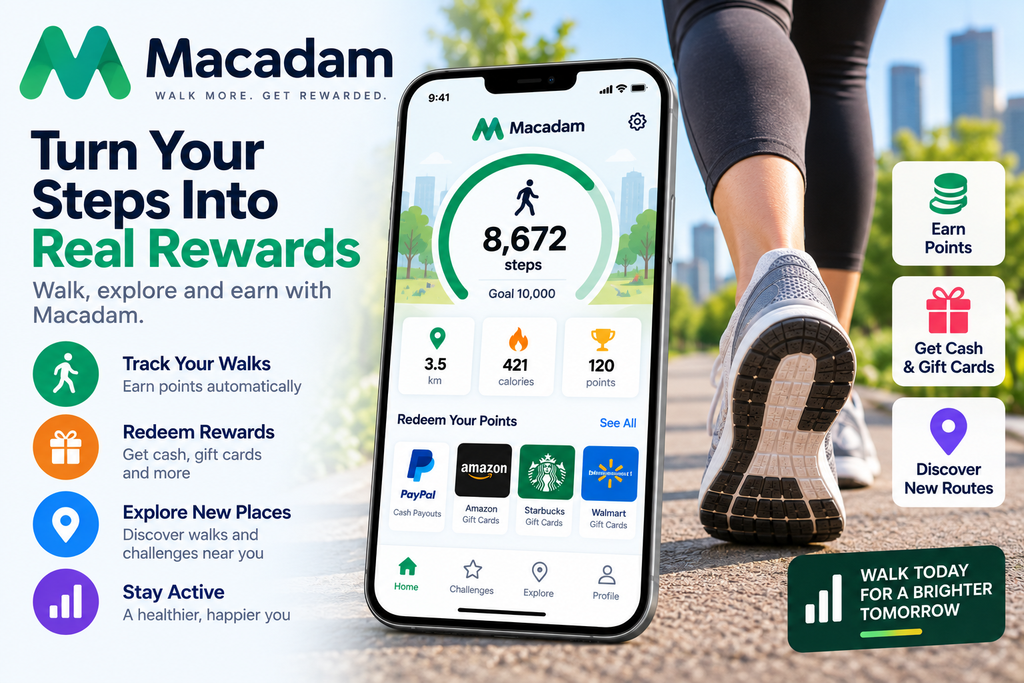
Macadam combines step tracking with a more game-like experience.
Users can earn Coins through walking and other activities, and the platform offers several types of rewards.
But this is one app where country restrictions matter a lot.
Macadam’s current terms, updated in June 2026, state that bank-transfer eligibility requires a European or U.K. bank account. The same terms also say that PayPal and gift cards are offered as alternative reward options.
That means an article aimed at U.S. readers should not simply promise a Macadam bank transfer.
The availability and reward options shown to you may depend on your country.
Pros
- Gamified walking experience
- iPhone and Android
- Multiple reward types
- Can make regular walks more engaging
Cons
- Reward availability depends on location
- European/UK bank-account requirement for the bank-transfer option
- Reward thresholds can change
- Some features may require additional activity
Our verdict
Macadam is interesting for users who want a more gamified alternative to simple step counters. U.S. users should check the current reward options available in their account before relying on a particular payout method.
7. StepBet — Best for Fitness Accountability, Not Passive Income
Best for: People who want strong motivation to hit walking goals
Available on: iPhone and Android
How it works: Place a bet on yourself, complete personalized activity goals, and share the prize pot with other winners.
Rewards: Potential cash winnings
Financial risk: Yes
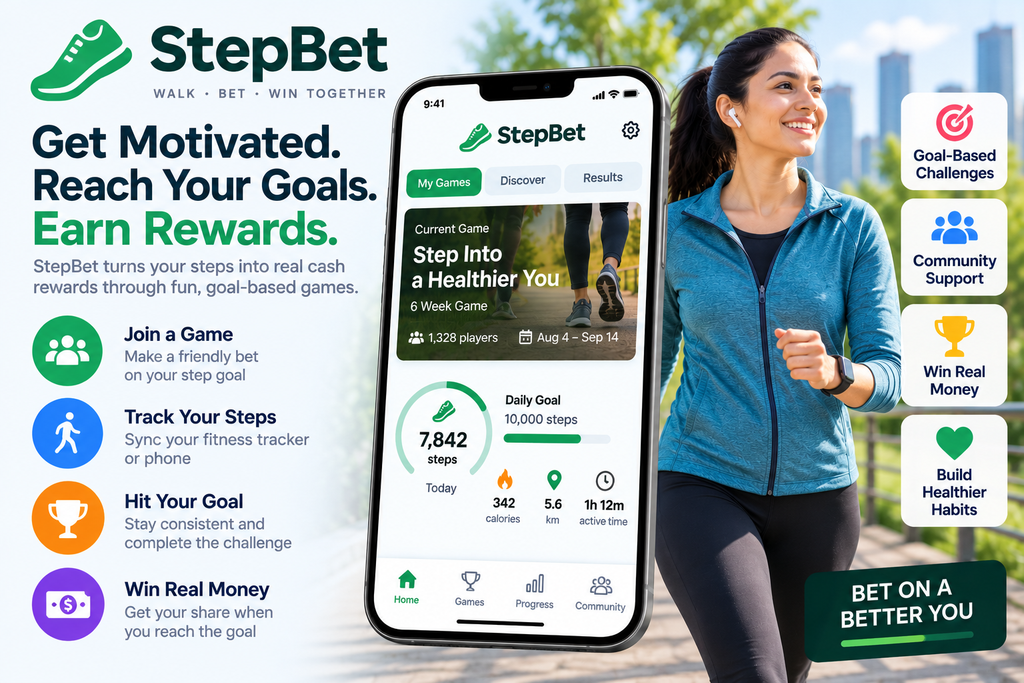
StepBet deserves its own category because it works very differently from CashWalk, Evidation or WeWard.
You don’t simply install the app and receive free rewards for walking.
Instead, StepBet is a fitness game in which you put your own money at stake.
StepBet uses your historical activity data to establish personalized Active and Power step goals. You then join a game by placing the required bet. If you complete the required goals throughout the game, you qualify to split the pot with other winners.
According to StepBet’s current FAQ, most bets are around $40, although the amount can vary by game. Most games last about six weeks, though the platform says duration can vary.
For player-hosted games, StepBet currently states that it reserves 15% of the gross pot for app development and fees, although it has a no-lose provision in certain circumstances where everyone wins.
This means StepBet has a potentially higher cash upside than a typical free step-reward app — but it also introduces genuine financial risk.
Pros
- Strong motivation
- Personalized step targets
- Real-money prize pools
- Useful for people who like accountability
Cons
- You have to put money at risk
- Missing required goals can cause you to lose eligibility
- Not passive income
- Payout varies according to the game and number of winners
Our verdict
StepBet is better described as a paid fitness challenge than an app that simply pays you to walk.
It can be useful for disciplined people who like having money on the line, but it should not be presented as a risk-free way to make money from walking.
8. Charity Miles — Best for Turning Walking Into Charity Donations
Best for: People who want their physical activity to support charitable causes
Available on: iPhone and Android
How it works: Log walking, running, biking and other eligible activities to generate sponsorship support for charities.
Personal reward: No
Cash-out: Not applicable
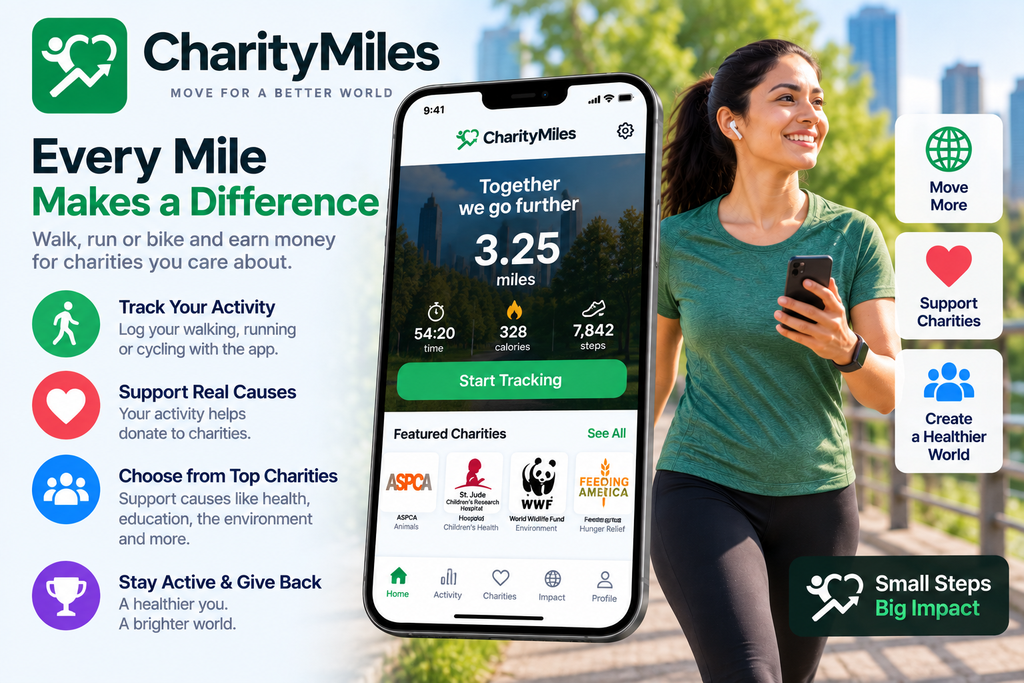
Charity Miles official website
Charity Miles is included here for a different reason.
It does not pay you personally.
Instead, it turns your activity into an opportunity to raise money for charitable organizations.
Charity Miles says users can walk, run, bike and otherwise get moving to make an impact, with sponsorships helping generate money for charity.
Its terms explain that the app uses device GPS to measure activity distance and that sponsorship money is earned on behalf of selected charities rather than paid directly to the user.
So we would not describe Charity Miles as a “cash-paying walking app.”
It’s better described as:
A walking app that helps generate charitable donations.
Pros
- Turns activity into charitable impact
- Free to use
- Useful motivational tool
- Supports recognized charitable causes
Cons
- You don’t receive personal cash
- GPS-based activity tracking may use more battery than basic step tracking
- Not suitable if your goal is personal financial rewards
Our verdict
Choose Charity Miles when making an impact matters more to you than receiving a gift card or cash reward.
Quick Comparison: Best Apps That Pay You to Walk
| App | Best For | Platforms | How You Earn | Main Rewards | Cash / Redemption |
|---|---|---|---|---|---|
| Evidation | Passive health rewards | iPhone, Android | Steps, health activity, cards, research | Cash, gift cards, donations | $10 per 10,000 points |
| CashWalk | Step-based gift cards | iPhone, Android | Walking and daily step rewards | Gift cards | Varies by reward |
| WeWard | Walking + challenges | iPhone, Android | Steps, challenges, offers | Cash, gifts, donations | Varies |
| Winwalk | Simple Android walking rewards | Android | Steps | Gift cards | Varies |
| Sweatcoin | Walking rewards and marketplace offers | iPhone, Android | Verified steps and activities | Sweatcoins, offers, $SWEAT | No standard PayPal/bank cash-out |
| Macadam | Gamified walking | iPhone, Android | Steps and activities | Cash/PayPal/gifts depending on region | Varies by country |
| StepBet | Fitness accountability | iPhone, Android | Personalized step goals | Cash prize | Requires a bet |
| Charity Miles | Supporting charities | iPhone, Android | Walking, running and other activities | Donations to charities | No personal cash payout |
Reward availability, thresholds, supported payment methods and app features can vary by country, account and time.
How We Rank Walking Reward Apps
At BetterPickForYou, we don’t rank these apps simply by the largest number displayed in an advertisement.
We Consider:
Reward Value
What do you actually receive, and how useful is it?
Ease of Earning
Can you earn naturally from activity you’re already doing?
Tracking
How does the app record your activity, and how much manual interaction is required?
Redemption
How easy is it to turn accumulated rewards into something useful?
Platform Availability
Is the app available on iPhone, Android, or both?
Transparency
Does the company clearly explain how its reward system works?
Privacy
Does the app clearly explain its use of activity, health or location data?
Time Versus Reward
Perhaps the most important factor:
Is the reward worth the time and effort involved?
Which Walking App Pays the Most?
There isn’t one app that objectively pays the most for everyone.
The reward structure is too different between platforms.
For example:
- Evidation uses a broader points system based on health activities and in-app actions.
- CashWalk converts steps into coins and gift-card rewards.
- WeWard combines walking with challenges and other activities.
- Sweatcoin provides its own in-app currency rather than standard cash.
- StepBet requires your own money to participate in a prize pool.
So comparing them using one simple “dollars per 10,000 steps” figure would be misleading.
For free walking rewards
Apps such as CashWalk, WeWard and Evidation are more directly relevant.
For potential cash winnings
StepBet can produce a larger cash outcome, but only because your own money is part of the challenge.
For marketplace rewards
Sweatcoin has a different value proposition.
For charitable impact
Charity Miles is the obvious choice, although the money goes to charity rather than you.
Can You Really Make Money Walking?
Yes, but don’t confuse earning rewards with earning a meaningful income.
Walking apps generally operate as incentive or loyalty systems.
The company may earn revenue from:
- Advertising
- Sponsored challenges
- Brand partnerships
- Health research
- Promotional offers
- Shopping or affiliate commissions
- Corporate wellness programs
A portion of that economic value can then be returned to users through rewards.
The result is usually modest.
That is why the smartest way to use these apps is to think:
“I’m getting a little extra value from activity I’m already doing.”
rather than:
“I’m going to make a living by walking.”
There is no reliable universal monthly income figure because reward systems, promotions, locations and user behavior differ.
How Much Can You Make From 10,000 Steps?
This is one of the most common questions — and one of the easiest to answer incorrectly.
There is no universal dollar value for 10,000 steps.
Different apps use different systems.
For example, CashWalk currently states that 100 steps earn one coin, but its reward catalog determines what those coins are worth in terms of available gift cards.
Winwalk similarly states that 100 steps earn one coin, with a 100-coin daily base cap.
Evidation doesn’t work that way at all. It awards points for several categories of activity, with 10,000 points redeemable for $10, rather than assigning a simple cash value to each step.
So any article claiming:
“10,000 steps always equals $0.10”
or
“10,000 steps always equals $1”
is oversimplifying the economics.
The better way to compare apps
Look at:
reward earned ÷ time and effort required
rather than simply:
steps ÷ coins
How Do Walking Reward Apps Make Money?
The business model varies from app to app.
Advertising
Some free apps display advertisements and use advertising revenue to help fund their reward systems.
Brand Partnerships
Companies may pay to have their products, challenges or offers presented to users.
Health and Research Programs
Platforms such as Evidation can connect participants with health-related research opportunities. Evidation explicitly describes its broader mission around health data, research and rewards for healthy actions.
Shopping and Promotions
Some walking platforms combine activity rewards with shopping or partner offers.
Corporate Wellness
Certain platforms work with companies or sponsors that want to encourage healthier behavior.
Understanding this business model can help you judge an app more realistically.
A company has to generate economic value somewhere in order to fund the rewards.
Are Walking Reward Apps Legit or Scams?
Many established walking-reward apps are legitimate businesses, but the existence of legitimate apps does not mean every walking app in an app store is trustworthy.
Before installing an unfamiliar app, look for:
Unrealistic earning promises
Be suspicious of claims that you can reliably earn a large daily income simply by walking.
Extremely high withdrawal requirements
A huge balance requirement can make a reward technically available but practically unreachable.
Pay-to-withdraw requirements
Never assume you need to pay a fee to unlock money you’ve supposedly already earned.
Unclear company information
Look for identifiable ownership, terms and support information.
Excessive permissions
A basic step counter does not automatically need continuous location access.
Poor privacy explanations
Walking apps may have access to health, activity or location information. Understand what you’re sharing.
Unclear reward rules
Read the terms before spending significant time completing a challenge.
And remember:
Legitimate does not mean highly profitable.
An app can be completely legitimate while still providing only modest rewards.
Privacy: What Data Do Walking Apps Collect?
This is one of the most overlooked issues in this category.
Depending on the app, you may be sharing:
- Step counts
- Activity information
- Distance
- Exercise information
- Health data
- Location data
- Device information
- Advertising identifiers
- Account information
Health and activity integrations can make apps more convenient, but they also mean you’re giving the service access to information from your device or health platform.
For example, Evidation’s supported integrations include Apple Health, Fitbit, Garmin and other health/fitness services.
Charity Miles can use device GPS to measure the distance of an activity.
Practical rule
Only grant the permissions the app actually needs for the feature you’re using.
If an app only needs step information, don’t automatically grant continuous location access unless its functionality genuinely requires it.
Always check the app’s current privacy policy before connecting health or fitness accounts.
Do You Need a Smartwatch?
No.
You can use many walking-reward apps with just a smartphone.
Apps such as CashWalk and Winwalk can use the phone’s built-in motion sensors/pedometer for step tracking. CashWalk also says wearable syncing is supported.
A smartwatch or fitness tracker can still be useful because it can record movement when your phone isn’t physically with you.
Whether a particular watch works with a particular app depends on the supported integrations.
How to Get the Most Rewards From Walking Apps
Walk Normally
The best walking-reward strategy is usually to monetize activity you’re already doing.
Don’t completely restructure your life for tiny rewards.
Compare the Actual Reward
Two apps might both advertise “coins,” but one coin can be worth something completely different from another.
Always compare the final redemption value.
Read the Rules Before Starting
Some offers are only available to new users.
Some challenges have deadlines.
Some rewards require specific actions.
Keep Tracking Working
Make sure the app has the permissions and health-data connections it needs.
A tracking problem can mean your activity isn’t credited.
Don’t Spend Money Just to Earn Rewards
If an offer requires you to buy something, calculate the economics before participating.
A $10 purchase to receive a $12 reward isn’t automatically a good deal.
Use Multiple Apps Carefully
Some people choose more than one legitimate walking-reward app.
That can make sense when the apps independently accept the same activity data and their terms allow it.
However, don’t attempt to manipulate your steps or use fake movement.
Check Your Rewards Regularly
Look at redemption rules periodically because reward catalogs and thresholds can change.
Important Things to Know Before You Start
Country Restrictions
An app’s features can vary significantly by country.
Macadam, for example, currently restricts its bank-transfer option to users with European or U.K. bank accounts, while offering other reward methods such as PayPal and gift cards.
Age Requirements
Some rewards and promotions may be restricted by age.
WeWard’s current terms specifically say certain rewards can be reserved for adults and that age verification may be required.
Tracking Requirements
Some apps require health-platform connections or specific permissions.
Redemption Rules
Always check the minimum reward requirement and available redemption methods.
Reward Changes
A reward program can change over time.
A blog post from two years ago isn’t necessarily evidence of what the app offers today.
Account Verification
Cash rewards may require identity verification or payment-account information.
Taxes
Cash and other rewards can have tax implications depending on the nature of the payment and your circumstances.
Do not assume there is one universal tax rule for every rewards app. Keep records of significant rewards and consult current IRS guidance or a qualified tax professional when necessary. The reporting rules for information returns differ by type of payment.
Walking Apps vs. Ordinary Step Counters
These categories are easy to confuse.
Step Counters
Apps such as standard phone health trackers primarily measure your activity.
Their purpose is health and fitness tracking.
Walking Reward Apps
Apps such as CashWalk or WeWard add a reward system on top of activity tracking.
You receive some form of incentive for qualifying activity.
Fitness Challenge Apps
StepBet is an example where the main goal is accountability and competition rather than passive rewards.
Charity Walking Apps
Charity Miles turns activity into support for charitable causes instead of personal income.
Understanding this distinction makes it easier to choose the right app.
Walking Reward Apps vs. Other Ways to Make Money
Walking-reward apps are fundamentally different from gig work.
A walking-reward app typically gives you a small incentive for activity you’re already doing.
A gig platform may pay you for completing an actual service or task.
So if your goal is:
“I want to earn a little extra from walking I already do”
a walking-reward app can make sense.
If your goal is:
“I need meaningful income from my time”
a traditional job, freelance work, gig work or another active income source will generally be a much more appropriate category to investigate.
Frequently Asked Questions
Can you really get paid to walk?
Yes. Legitimate apps can reward walking or other physical activity with points, gift cards, cash rewards, discounts, donations or other incentives. The reward structure varies significantly between apps.
What is the best app that pays you to walk?
There isn’t one universal winner. CashWalk is a strong choice for people who primarily want step-based gift cards, while Evidation is particularly useful for passive health/activity rewards. WeWard is a good fit for users who enjoy walking challenges and multiple reward options.
What app pays the most for walking?
There is no reliable universal winner. StepBet can produce larger cash outcomes than free rewards apps, but it requires your own money to participate and you can lose eligibility if you fail to meet the required goals.
How much can you realistically make walking?
There is no reliable universal monthly figure. Most walking-reward apps are better viewed as a source of occasional small rewards rather than meaningful income.
How much can you make from 10,000 steps?
There is no universal dollar amount. Each app uses its own reward formula, daily limits and redemption system.
Which walking apps pay through PayPal?
Current app documentation indicates that options such as Evidation and WeWard can offer PayPal-based rewards, while Sweatcoin does not provide a standard direct PayPal cash-out for Sweatcoins.
Is Sweatcoin real?
Yes, Sweatcoin is a real walking-rewards platform. However, Sweatcoins are an in-app currency rather than ordinary cash, and standard users cannot directly withdraw a Sweatcoin balance to PayPal or a bank account.
Is WeWard legit?
WeWard is an established walking-rewards platform whose current terms describe Wards earned from steps and other in-app activities and explain the process for cash rewards.
Is CashWalk legit?
CashWalk currently operates as a step-reward app that awards coins for walking and offers gift-card redemptions. Its official site documents its current step and coin system.
Do walking apps work on iPhone?
Many do. CashWalk, WeWard and several other major walking-reward platforms currently support iPhone, although exact features may vary.
Do walking apps work on Android?
Yes. Many walking-reward apps support Android. Winwalk, for example, currently operates through Android and uses the phone’s built-in pedometer for step tracking.
Do I need a smartwatch?
No. Many apps can track steps using your smartphone. A compatible smartwatch or fitness tracker is optional and can be useful for recording movement when your phone isn’t with you.
Are walking reward apps safe?
Don’t assume every app is safe simply because it has many downloads. Evaluate the developer, privacy policy, permissions, reward terms and reputation before connecting health or location data.
Can I use more than one walking app?
Sometimes, yes. Multiple apps can potentially use the same underlying activity data, but you should follow each platform’s terms and never manipulate or falsify activity.
Final Verdict
Walking-reward apps can be a useful way to get a little extra value from something you’re already doing.
They are not a replacement for a job, and the smartest users don’t treat them as one.
Best for step-based gift cards: CashWalk
CashWalk is a strong choice when your main goal is to turn regular walking into gift-card rewards.
Best for passive health rewards: Evidation
Evidation makes sense for people who already use health and fitness tracking and want to earn rewards from a broader range of healthy activities.
Best for walking challenges: WeWard
WeWard is a good option for people who enjoy gamification, challenges and multiple reward choices.
Best simple Android option: Winwalk
Winwalk is worth considering if you want a straightforward Android walking-reward app focused on gift cards.
Best for motivation with money on the line: StepBet
StepBet is fundamentally different because you put your own money into the challenge. It can motivate disciplined walkers, but it should not be confused with risk-free passive earnings.
Best for charity: Charity Miles
Charity Miles is the choice when you want your activity to support charitable causes rather than generate personal income.
The biggest lesson is simple:
Don’t choose a walking app because it promises the biggest number. Choose it because its reward is useful, its rules are clear, and the reward is worth the time and data you’re giving in return.
And remember: your steps already have health value. Any gift card, cash reward or charitable impact you receive should be considered a bonus.